
Our currently dominant industrial food systems are shaped by unequal power, short-term incentives, and decision-making that excludes those most affected, and yet a future where food systems are fair for people, animals and the planet is possible.
We are living through a period of profound disruption. Climate shocks, rising food insecurity, worsening public health and growing pressure on farmers are exposing the fragility of a food system that is struggling to deliver for people, communities and the planet. At the same time, trust in institutions is declining and public debate is becoming more polarised, making collective action harder just when it is needed most.
Key challenges facing the ethical food system include:
- Underfunded transformation
Ethical food systems solutions lack the investment needed to scale and sustain the change needed, whilst the status quo continues to be reinforced. - Disconnected efforts
Ethical food system organisations and actors with shared goals often work in isolation and in competition, limiting their collective power. - Excluded voices
Communities most affected by food injustice are too rarely shaping the decisions that affect them.
The result? A food system that too often fails to deliver fairness, dignity and long-term wellbeing for people, for animals or for our planet.
And yet, this is also a moment of opportunity.
Food is increasingly recognised as a critical lever for addressing interconnected challenges across health, climate, nature and economic resilience. New policy windows are opening, community-led initiatives are growing, and a new generation of leaders is demanding change. The decisions made in the coming years will shape the future of our food system for decades. To seize this opportunity, people need more than evidence of what is wrong – they need a shared sense of what good looks like and practical ways to move towards it.
This is where the Food Ethics Council has a vital role to play. We want to hold what’s difficult, so that coherence becomes possible. By bringing ethics into decision-making, convening across divides and helping people navigate complexity, we can turn fragmentation into collective action and support the transition to a food system that offers fairness, dignity and long-term wellbeing for all.
The Food Ethics Council confronts turbulence with steadiness and a stubborn willingness to keep asking the questions that matter most when the world feels so volatile. That’s what being rooted in ethics looks like: the discipline of continually returning to asking who decides, who benefits, and who is left out.
Elta Smith, Chair, Food Ethics Council
We know that alongside shifts in food policy and business, we need a shift in funding, to enable civil society to become more resilient and better-resourced. The need for these shifts directly informed a strategy renewal process in early 2026, representing the culmination of months of careful work across our team and Council members, alongside valuable input from Nadeen Haidar and Anna Cura.
Our strategic directions for 2026-2030
From 2026 through to 2030, our work will focus on the three core strategic pillars outlined below.
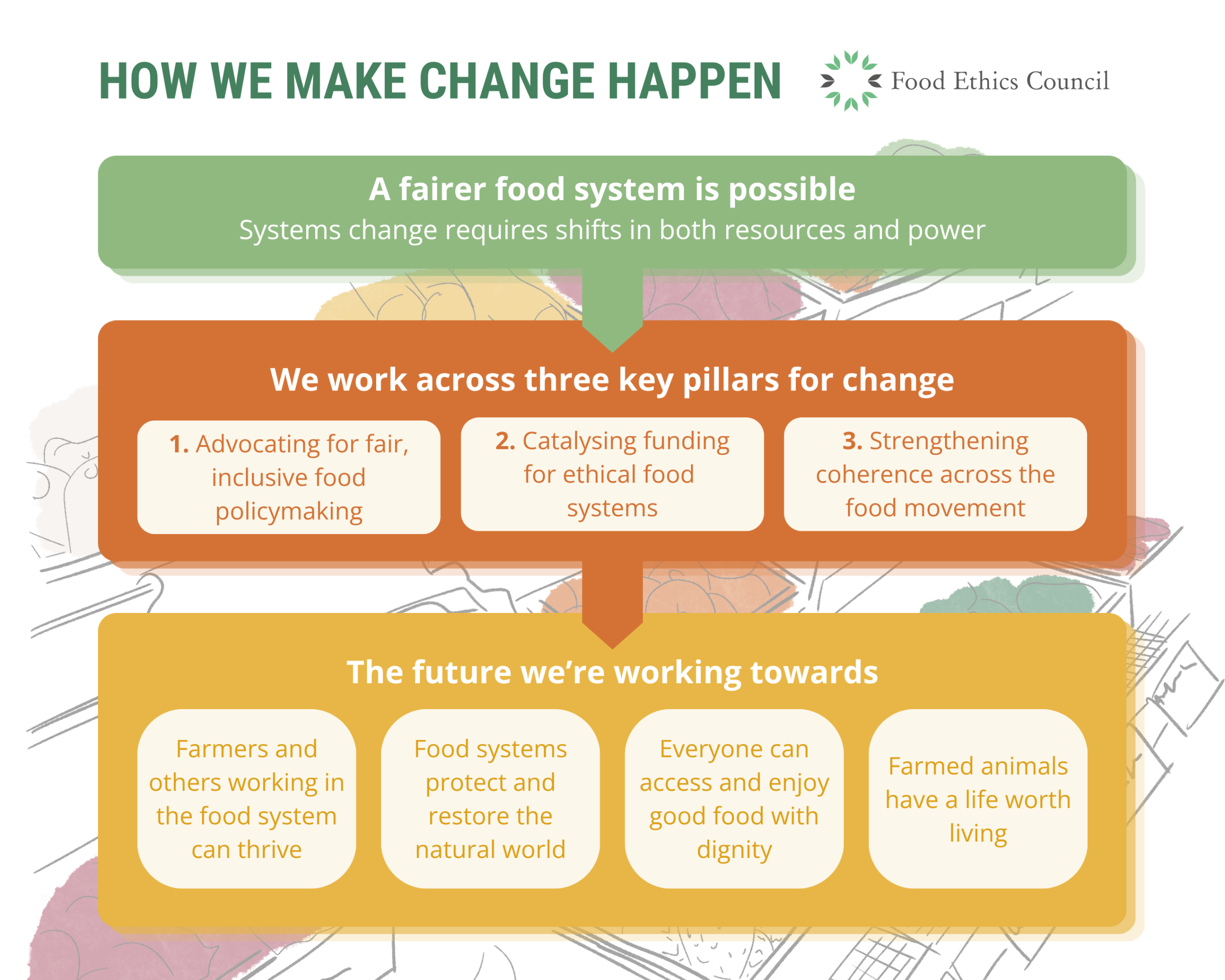
1. Advocating for fairer, more inclusive food policymaking
Our focus is on shifting UK food policy towards fairness, inclusion and root-cause thinking.
This matters because policy sets the rules of the food system, and yet policymaking itself is often fragmented, short-term and exclusionary.
We work to do this by championing fairer, more inclusive policymaking that is built upon meaningful citizen voice, and by advocating for long-term foundations for change such as the Right to Food, a UK Food Bill and a coherent Food Strategy.
Indicators of progress include: greater commitments to fairness and inclusion in food and farming policymaking; increased traction for the right to food and other long-term policy foundations; and ethical approaches becoming more visible in campaigns, the media, and public debate.
2. Catalysing ethical food systems funding
Our focus is on encouraging increased investment in ethical food systems, with capital shifting towards meaningful long-term change.
This matters because funding determines what change is possible, but to date investment remains largely misaligned with what is needed for successful positive transformation of our food systems.
We work to do this by making and evidencing the case that ethical food systems are both essential and currently underfunded, and by working with funders and food system organisations to shift investment towards deep-rooted transformation.
Indicators of progress include an increase in investment in ethical food systems across the UK, and funders and civil society becoming visibly more aligned around long-term systems change.
3. Strengthening coherence across the food movement
Our focus is on strengthening coherence across progressive food and farming businesses and civil society, through trusted spaces, shared learning, and collaboration.
This matters because, whilst fragmentation limits impact, greater coherence increases collective power and influence.
We work to do this by: creating and facilitating trusted forums to explore root causes and routes forward; sharing insights, tools and learning to strengthen ethical practice across the sector; promoting coherence and collaboration across progressive food system civil society and enterprise; and championing marginalised voices, challenging injustice and serving as allies.
Indicators of progress include visibly greater coherence across food movement actors working for change, with ethical approaches becoming more visible across their work and general discourse.
Learn more
The slide deck below sets out our strategic directions for 2026-2030 in further detail, with a shorter version available here: Food Ethics Council Strategy 2026-2030 Narrative Deck (Short)