
The Right To Food UK Commission, which is led in Parliament by Ian Byrne MP for Liverpool West Derby, was established as a partnership between the Right To Food Campaign, the University of Westminster, the Bakers, Food and Allied Workers Union (BFAWU), and the Food and Work Network.
It aims to consider:
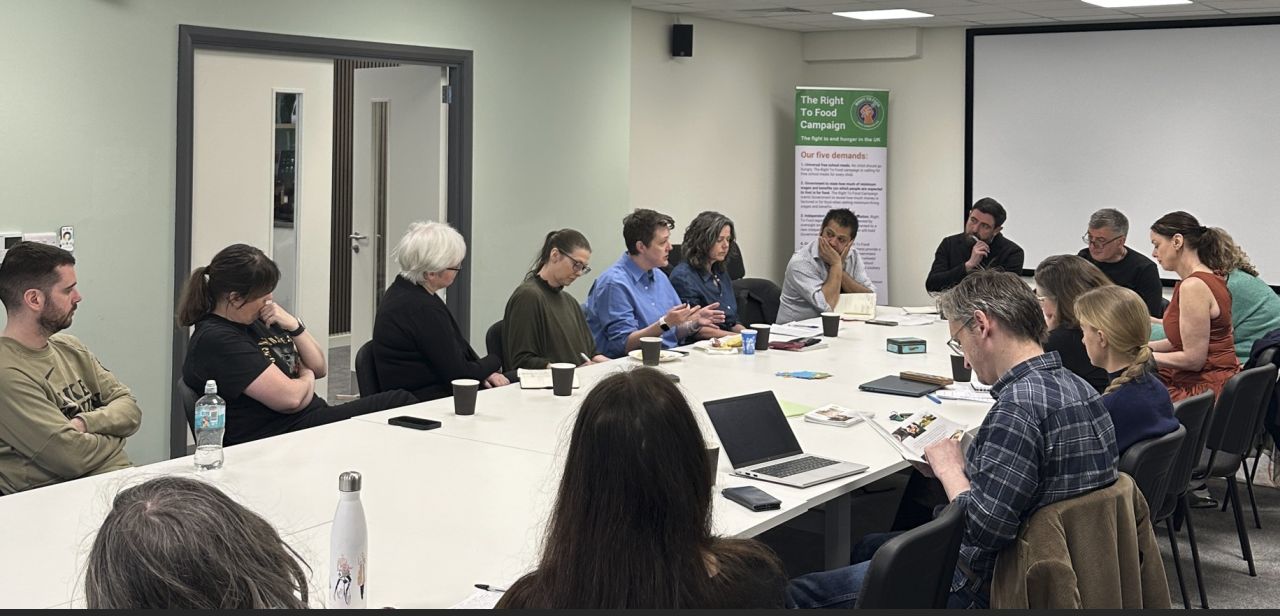
Following its launch in Parliament on 17th November 2025, the Commission has held evidence sessions across the UK, in Liverpool, Newcastle, Belfast, Glasgow, Cardiff and London, as well as opening a call for submission of evidence more widely.
Below is the statement submitted by the Food Ethics Council under this call for evidence, as prepared by our Deputy Director Beth Bell, who leads on our ongoing work around the Right to Food and who presented in person at the Belfast evidence session.
Our submission is also available to download here as a pdf document: Right to Food Commission’s Call for Evidence submission from Food Ethics Council.
Statement from the Food Ethics Council – June 2026
The Food Ethics Council welcomes the opportunity to submit to the Right to Food Commission’s Call for Evidence.
We are a UK wide charity working to embed ethics at the heart of food system transformation. We work with our council members and peers to dig deeper into the right to food to develop greater understanding of what it is, what it isn’t and how it can be meaningfully enacted.
It is our contention that the right to food is everything to do with food but not only to do with food. By which we mean it’s about the conditions across the system that create the “enabling environment in which people can use their full potential to produce or procure adequate food for themselves and their families.” (The Right to Adequate Food, The Office of the United Nations High Commissioner for Human Rights (OHCHR).
Our work is guided always by the words of Christina Adane, a member of the Food Ethics Council and youth activist, who notes that people ‘can’t make good choices if they don’t have good options’. The right to food would systemically and structurally deliver the options.
The right to food is paradoxically regarded as both highly complex, and very simple. It is described as an undeniable moral fact, a highly contested legal concept, an activist statement with limited practical application, a part of a broader rights package that needs to be in balance, and much more besides. But what we can say is that if the right to food is to be meaningfully embedded and enshrined in law, we must be clear that a true right to food has nothing to do with charity and everything to do with government duty and collective agency.
The right to food is also not just about the here and now. We would encourage a right to food framework built on the phrase ‘Good food, for everyone, forever’ (originated by Colin Tudge).
‘Good food’ is about more than calories. It means food that is nutritious, culturally appropriate and supports health and wellbeing. ‘For everyone’ means food that is accessible and affordable, while protecting dignity and ensuring fair livelihoods for the people who grow, process, transport and sell it. And ‘forever’ reminds us that food must be produced within nature’s limits, caring for land and water and contributing to a climate-safe future. The latter is too often neglected.
Our responses:
1. Food insecurity in the UK, challenges and solutions that are having a positive impact
We have written, and contributed to, a great deal of work on food insecurity, poverty, hunger and hardship. In particular we would highlight Hungry for Change, the final report of the Fabian Commission on Food and Poverty, chaired by FEC member Geoff Tansey. Although published in 2015, it remains entirely relevant, indeed many of the circumstances outlined have worsened:
“The Commission has uncovered a crisis of food access for many households in the UK. There are multiple cases of parents – usually mothers – going hungry to feed their children or having to prioritise calories over nutrients to afford their weekly food shop. Many people are feeling a deep sense of anxiety from the struggle to manage serious squeezes in household budgets that arise from the cost of living rising faster than income.”
The Commission then called on government to take coordinated action to address household food insecurity:
“The emphasis on personal, professional, civic and corporate responsibility from the current and previous governments has moved responsibility to individuals, businesses and charities, but the power remains firmly with government. Current and future governments can only tackle poverty, improve access to food, and advance public health by taking coordinated action. To eliminate household food insecurity in the UK, governments need to take responsibility for it directly.”
The Commission outlined the issue with attempting to tackle food insecurity by making food cheaper:
“The key dilemma in the food system is that changes to tackle climate change, improve health and address working poverty in the food workforce could push up food prices, reduce choice, and make it harder for people on low incomes to access affordable food. However, the cost of inaction on these issues is likely to be worse for low- income households over the long term: even higher food prices, even further reduction of choice, even worse health outcomes, and worse pay conditions for the food workforce. There are no ‘win-win’ situations in which simple policy fixes can both solve the food system’s unsustainability issues and keep food prices low. However, this should not be an excuse to shy away from the big changes that need to be made to make the food system more sustainable, improve health outcomes, and to ensure fair working conditions are provided to the food system workforce. The challenge is to ensure that the changes that need to be made do not disproportionately impact upon people on low incomes. Therefore, as a Commission we believe there must be a new focus on improving incomes rather than keeping prices artificially low at the expense of the environment, public health and working conditions in the food supply chain. Eliminating household food insecurity at the same time as fixing the food system’s structural unsustainability will mean ensuring everybody has a sufficient income to be able to manage the higher food prices of the future.”
Additional resources and insights are linked below.
https://www.foodethicscouncil.org/insights/building-community-food-resilience/
https://www.foodethicscouncil.org/wp-content/uploads/2022/07/APPG-response-on-food-banks.pdf
https://www.foodethicscouncil.org/opinion/food-banks-are-now-normalised-this-is-a-failure-of-state/
2. No response
3. No response
4. Experiences of the impact of community kitchens
We would highlight Nourish Scotland’s work to codify and promote public diners as a powerful systemic response to many issues within the food system (noting that public diners are distinct from community kitchens). The newly launched Public Diner website has the following to say on the right to food:
“We have the right to education, we have the right to healthcare – we also have the right to food. That means the state has to step up to support a food environment where citizens can choose, afford and enjoy the food that will keep them well. Public diners offer the State a mechanism through which they can deliver their duty to protect the right to food.
The right to food is the right to be able to choose, afford and enjoy food. The duty on the State is not to hand out food but to provide an “enabling environment in which people can use their full potential to produce or procure adequate food for themselves and their families.” Yet, in the UK today, barriers to accessing and affording good food are multiplying unevenly. It’s not just that the cost of a healthy, sustainable diet is more expensive than an unhealthy one, time and energy to cook is being squeezed by working schedules, some towns have 5 grocers, others have none.
That the state allows this environment to continue is not only in violation of the right to food – it’s also unique. Consider water, for example, another one of our basic human rights – we have made sure everyone has universal access to that regardless of income. The same goes for healthcare, education, even wifi access. Here the state has stepped in with the recognition that these things are too important for us to leave entirely to the market. Public diners are a response to this same recognition: our right to food is too important to leave to markets. They are a way for the State to discharge its responsibility to make good food available for all.”
5. Experiences of the impact of social protection safety nets such as income support
We would highlight the work of academic Dr Jasber Singh (Centre for Agroecology, Water and Resilience (CAWR), Coventry University) who articulates how many of the proposed enactments of the right to food in fact exclude groups of people resident in the UK, namely those with no recourse to public funds. Increasing the rate of Universal Credit or the minimum wage to enable people to be able to purchase sufficient, culturally appropriate and nutrient rich food for their needs does nothing to enable or empower people with no recourse to public funds to do the same.
A VOICE FOR THE VOICELESS Through the lens of lived experience: No Recourse to Public Funds, the violation of human rights, and resilience to it. (Research Team: Jasber Singh, Hannah Hoseyni, Oluwatosin Kuforiji and members of United Impact)
6. Evidence on the importance of a living wage for all on the ability to feed individuals and families
As noted, it is our belief that household food insecurity, and broader food security, can only be meaningfully tackled by taking a systemic approach. One key aspect of the system is ensuring that all work is fairly paid. We highlight the work of the Living Wage Foundation here in particular Life on Low Pay 2025: The impact of low wages on UK workers which notes the following key findings:
7. No response
8. Evidence on solutions that reach those most marginalised including homeless, unemployed and those living with ill health or disability
We would again highlight the work of Dr Jasber Singh whose research deepens understanding of the dearth of solutions to the right to food that address the needs of refugees and asylum seekers i.e. those without citizenship of the UK.
A VOICE FOR THE VOICELESS Through the lens of lived experience: No Recourse to Public Funds, the violation of human rights, and resilience to it. (Research Team: Jasber Singh, Hannah Hoseyni, Oluwatosin Kuforiji and members of United Impact)
“Levels of food insecurity have been rising since 2008 and up to ten million people go without sufficient nutritious food in the UK, despite it being the fifth biggest economy in the world (12). A lack of nutritional and culturally appropriate food causes profound physical and mental health hardships for families and individuals. The reasons for these rising levels of food insecurity are complex and linked to, but not exclusively to, inadequate social security, inadequate pay and poor working terms and conditions, the immigration condition of NRPF, the rising costs of living, structural racism, ableism, and sexism (9,13–17).
Food insecurity remains a problem, even though the UK government is currently a signatory of a range of United Nations instruments and conventions that ask nations to ensure that no one goes hungry or experiences food insecurity. For example, the UN Convention on Human Rights 1948 and the International Covenant on Economic, Social and Cultural Rights 1976 both advance the right to food. Dowler and O’Conner (18) identify a simple and powerful idea at the heart of discourse around the right to food: they argue that if access to food were considered a fundamental human right and incorporated into domestic law, this would compel the government to transform policies and social conditions that lead to wide-spread food insecurity (19–20). Since this is not currently the case, the state does not have a legal responsibility to ensure that all households and those without housing have access to nutritious food.
Viewing food as a human right is already part of domestic law in many countries across the globe, including Scotland (21). A Right to Food campaign is gaining ground because many commentators argue that this social protection ought to be extended to the rest of the UK (22). Right to food violations are often caused by poverty. Given that inadequate purchasing power has an impact on all aspects of life, the right to food also needs to be advanced alongside other social cultural and economic rights which also tackle poverty, such as the right to adequate housing and access to adequate social security.
Universal inalienable rights are mediated through the relationship between the state and the citizen. However, people seeking asylum are largely overlooked when it comes to their universal and inalienable rights, as they are not considered ‘members’ of a given state; in effect they are often rendered stateless and thus legally viewed as ‘non-citizens’. One of the goals of the right to food is for it to be incorporated into domestic law, to enable entitlements to tackle food insecurity. However, such a law might not apply to those considered non-citizens, and if the entitlements are considered public funds, they certainly would not apply to people who have NRPF. There is a real risk, therefore, that the entitlement afforded through right to food, and other social, cultural and economic rights, may not apply to people subjected to NRPF, and this indicates that the challenge of hunger is arguably bigger than incorporating rights into law alone.”
Additionally, we would direct you to a recording of an event in January 2025 which we opened with powerful recordings of people reflecting on food, rights and insecurity.
Real Voices on the Right to Food – Oxford Real Farming Conference 2025
9. How a right to food law could work in the UK, including evidence from right to food cities on lessons learned
We would highlight this article published in April 2025 that we co-authored with the Global Food & Environment Institute, The Right to Food in the UK: Moving from third sector solutions to Government action, which notes:
“Unlike the UK, many states around the world contain the right to food either in their constitutions or legislation. The right to food was added to the Brazilian constitution in 2010. Brazil has also implemented a law on national food security, created a National Conference on Food and Nutritional Security that facilitates citizen participation, and provides universal free school meals. Between 1990 and 2015 these measures have reduced the percentage of the population suffering from hunger from 14.8% to 1.7% and reduced childhood malnutrition rates by 73%. In the Dominican Republic, the constitution does not explicitly guarantee the right to food. Instead a law that acknowledges that adequate food is a fundamental right has been passed. Such approaches to legislating for the right to food show that even without the right to food appearing in a constitution, laws to transform food systems and improve the realisation of the right to food can be implemented. The UK Government is responsible for the realisation of the right to food, yet the UK central Government has not considered such legislation. Devolved governments and local authorities have a role to play, but it is ultimately the UK Government that is responsible for the obligations and duties the right to food creates.
Scotland has made some positive steps in its food policy by enacting the Good Food Nation (Scotland) Act. This Act requires creation of plans and setting of associated outcomes that are then scrutinised by Parliament. Scotland has also stated it is aiming to eliminate the need for food banks. As most hunger and food insecurity in the UK is due to poverty, Scotland’s choice to address this issue are limited as welfare budgets are mainly set at a central UK level. Local authorities also make some food-related policy. They have a role in childhood diet-related health plans, and planning law can help ensure people have access to food shops that contain a variety of nutritious foods. They determine local policy in relation to free school meals and can use Household Support Funds to help prevent families from going hungry. Transport for London banned advertisement of high in fat, salt, and sugar foods across its network in 2019, and this has resulted in lower levels of energy, sugar and fat purchased in households in London. The success of this approach has led to similar measures being introduced by several London Borough Councils. South Tyneside Council has refused permission to a development of fast food outlets, indicating that such a development did not align with local policies in place to tackle diet-related ill health.
States have a fundamental obligation to ensure people in their jurisdiction are not going hungry. States also have a set of core obligations in relation to ensuring all can access an adequate diet, that they should prioritise. Implementation of these obligations requires a clear national policy and approach. Without a joined up and coherent UK food plan, which can be guided by the content of the right to food, the right to food is unlikely to be fully realised in the UK, as stated by the by the House of Lords Food Diet and Obesity Committee in 2024: ‘The Government must as a matter of urgency adopt a new, comprehensive and integrated food strategy to address the wide-ranging consequences of the food system failures identified in this report. Implementation of such a strategy will only be successful on the basis of strong and accountable leadership at the highest level of government’. Such a plan needs to be based on the right to food, putting the rights of people and the obligations of government at the heart of the plan. A right to food framework shifts from an economic framing of food systems based on supply, demand, and distribution. It also identifies and provides the potential to challenge power in the food system to bring about positive change.”
Additionally we would highlight this webinar that we conducted with Nourish Scotland to make the right to food more widely understood:
What do we mean when we talk about a right to food?
10. What should the right to food law include regarding government duties?
As well as the information articulated in Q9, we would also highlight this piece by Food Ethics Council Chair Elta Smith, From Charity to Rights: How European Food Strategies are Making Food Security a Reality.
“Across Europe, these challenges are being addressed in various ways. They show that creating fair food environments benefits everyone by making healthy, sustainable choices easier and more accessible. This represents a crucial shift in thinking—away from interventions that focus on food access as an individual responsibility, which dominate in the UK, and towards creating environmental conditions that enable everyone to thrive. As multiple examples from other European food policies demonstrate, systematic policy change delivers universal benefits that strengthen our collective food security. Crucially, this approach connects to the right to food as a universal entitlement rather than welfare provision, shifting accountability from individuals and charities to systems and governments.”
11. How could we monitor the impact and progress of a right to food law?
Hungry for Change, the final report of the Fabian Commission on Food and Poverty, chaired by FEC member Geoff Tansey contains insights on this across pages 24 and 25:
“2. Monitoring the right to food
The new minister and devolved governments should take responsibility for their duties to respect, protect and fulfil the right to food, while civil society organisations should form an alliance to monitor the government’s compliance. The right to food, as set out in the Universal Declaration of Human Rights and the International Covenant on Economic, Social and Cultural Rights and to which the UK is a signatory, is about the right to feed oneself and one’s family with dignity. This ‘rights-based’ approach to food places access to food within a social justice framework.136 Guidance on the right to food published by the UN Committee on Economic, Social And Cultural Rights states that: The right to adequate food is realized when every man, woman and child, alone or in community with others, have physical and economic access at all times to adequate food or means for its procurement. The right to adequate food shall therefore not be interpreted in a narrow or restrictive sense which equates it with a minimum package of calories, proteins and other specific nutrients. The right to adequate food will have to be realized progressively. However, states have a core obligation to take the necessary action to mitigate and alleviate hunger as provided for in paragraph 2 of article 11, even in times of natural or other disasters. Source: UN Committee on Economic, Social and Cultural Rights (CESCR), General Comment No. 12: The Right to Adequate Food (Art. 11 of the Covenant), 12 May 1999 Despite being a signatory to the International Covenant on Economic, Social and Cultural Rights (1976), the UK has not yet given it legal status under domestic law.137 The doctrine of parliamentary sovereignty means that state international law needs to be translated into domestic law if it is to be applicable.138 In England, the new minister should take responsibility for the government’s commitment to protect, respect and fulfil the right to food. Welsh and Northern Irish devolved governments, who have responsibility for human rights in their jurisdictions, should take the same step. This will mean committing to ending household food insecurity – under the principles of ‘progressive realisation’ (which means working towards the objective at a pace at which resources allow).
In Scotland, where the right to food is already an established subject of debate within civil society, the cabinet secretary for social justice should consider enshrining the International Covenant into Scottish law, building on the human rights legislation in the Scotland Act 1998. With the right to food, Scotland has the opportunity to take the lead in the UK, working to chart the route to the elimination of household food insecurity that other nations are able to follow.
Meanwhile, civil society organisations across the UK should form an alliance to monitor the government’s progress, as ‘principal duty bearer’, for its compliance with its obligations under the right to food.
This alliance should also work with those experiencing poverty and household food insecurity, as well as those looking for an outlet to push for more structural change in the UK food system to put pressure on the government to deliver on the right to food. A model for such an alliance could be the group of civil society organisations that supported the recent report Square Meal: Why we need a new recipe for the future (2014), which included the Food Ethics Council, Sustain and Friends of the Earth. Such an alliance should include organisations working with those in poverty, such as Church Action on Poverty, and people with direct experience of poverty, such as those on the Commission’s Expert Panel.
This monitoring role should include bringing to public and political attention the five-year periodic reviews presented to the United Nations Committee on Economic Social and Cultural Rights by the UK government with regard to the progress undertaken in realising the right to food and achieving food security for all within the context of an adequate standard of living.”
12. What type of accountability mechanism would ensure the voices of those most impacted are collected and acted upon?
In MONITORING SOCIAL INCLUSION AND THE RIGHT TO FOOD AND NUTRITION IN EUROPE, Dr Jasber Singh outlines four steps to move right-to-food monitoring in a socially inclusive direction:
“Step one involves recognizing the fact that the perspective of the UK and Europe is currently muddled by the post-race, post-gender, post-homophobic, post-difference paradigm. This guise fails to acknowledge the material and performative power that race, gender, and other axes of difference continue to wield. Step two consists of a firm commitment to constructing a socially inclusive approach to monitoring. To do this, we suggest that the right to food intentionally record and analyse the relationship between difference and right to food violations. Step two also entails a critical race approach whereby race is placed at the centre of an intersectional analysis. This intersectional analysis would also address disability, immigration/citizenship status, and other categories of difference. Step three, based on the premise ‘nothing about us without us’, involves using creative participatory action research approaches to centre the lived experience of those most affected by right to food violations. This step also adds nuance to monitoring and ensures that analysis and solutions are coproduced by those who suffer from right to food violations. Step four activates the knowledge generated by a socially inclusive approach to disrupt the post-difference narratives in general and among practitioners and policy-makers specifically.”
Conclusion
We would also highlight our pioneering work to develop and embed the concept of ‘food citizenship’ in UK civil society. The Food Ethics Council, originally partnering with New Citizen Project in 2016-17, introduced and popularised the idea that people should be treated as citizens shaping the food system, not just consumers buying within it. This food citizenship framing has since been adopted by local authorities, national NGOs and more than 100 UK food partnerships, informing programmes on participation, co‑design and community food governance. It has changed how organisations design interventions — from transactional to participatory. Visuals and details are available here.
“Food citizenship is much more than having the privilege to choose good food. It is about having individual and collective agency within a society where capitalism, social inequities, and a complex food web intersect. It demands of us a responsibility to be truly humanitarian, to be protectors of nature and to stand for real democracy and human rights. Our food citizenship places us as rights bearers at the heart of the right to food, to hold our government accountable to its duty to ensure all people are able to access culturally appropriate, healthy, sustainable and just food.”
Dee Woods Co-founder Granville Community Kitchen and member of the Food Ethics Council
Finally, in the words of Juan Echanove Echanove of the Food and Agriculture Organisation:
“The Right to Food asks not only whether policies improve resilience, but who has obligations, what outcomes must be guaranteed, who remains excluded and what accountability exists when systems fail.”
With appreciation for the Commission’s work,
Beth Bell, Deputy Director, Food Ethics Council
Featured image by Arun Pushpam Raj on Unsplash.