
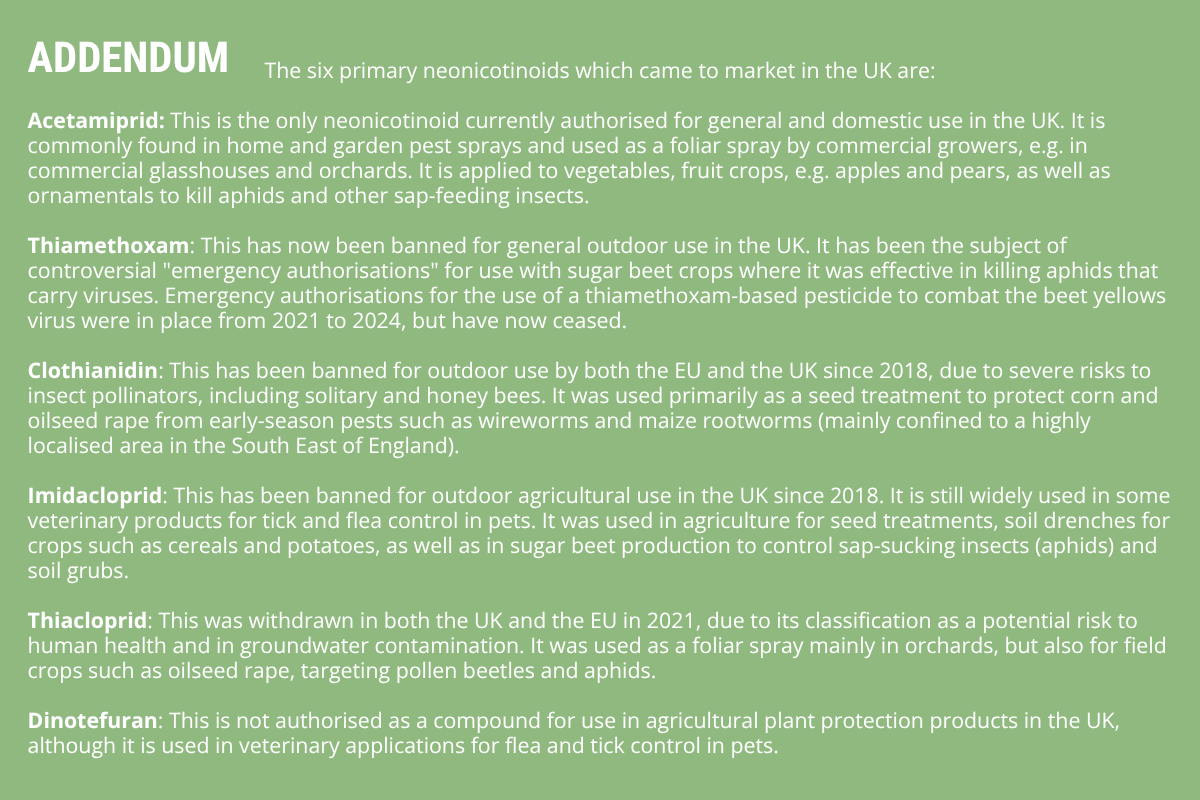
In this ‘long read’, Council member and Trustee of the Food Ethics Council, Ralph Early, charts the development of insecticides and brings focus to neonicotinoids – or ‘neonics’ as they are often abbreviated – from the promise of increased agricultural yields to recognition of harmful ecological impacts. This is part one of a two-part article. The later second part will explore the ethical implications of synthetic pesticide use, particularly as a moral dilemma for the farmers that keep us fed.
“Fundamental to human survival is the perennial problem of nutrition and food supply. Countless bacterial and fungal species, as well as numerous types of virus, promise human infection.”
Neonicotinoids are a class of synthetic insecticide. They are widely used in agriculture and particularly in the cultivation of crops that serve human food needs, either directly as with oilseeds grown for edible vegetable oil or indirectly via crops grown as food for farm animal production. As a specialised technology designed for crop production, their capacity to eliminate and control insects classified as pests is indeed remarkable. However, an apparent downside is that non-target insects such as pollinators essential to agriculture and sustainable food systems are also poisoned by these compounds. This then raises practical and moral concerns about their accumulative effects for wild nature and the long-term survivability of diverse ecosystems in the context of Planetary Boundaries[1] and biodiversity itself as a core boundary.
The development of neonicotinoids as a solution to pests in agriculture and horticulture, as well as in treating fleas and ticks in domestic pets, extends as a fascinating thread from the early days of pesticide development in the 19th century to the present day. The purpose of this ‘long read’ is to provide the reader with an overview of technical aspects of the topic, leading into part two and an applied food ethics analysis of the use of insecticides.
[1] See: https://www.stockholmresilience.org/research/planetary-boundaries.html
Origins: A look back at history
If there is one thing at which human beings excel as a species, it must surely be the ability to kill and even to eliminate completely other species with which they share the small speck of interstellar dust they call planet Earth. A speck of dust that is and can only ever be home[1]. History tells of the ways in which Homo sapiens learned how to use a wide variety of plants and animals for their own survival, of which some in particular also served as catalysts for human social and creative development. This we see for example in the Sulawesi cave-paintings in Indonesia which tell of a hunt some 51,000 years ago and long before the arrival of agriculture.
With the development of agriculture some 12,000 years ago, the human talent for selectively breeding plants and animals came into its own. This technology has long underpinned agriculture, allowing species to be restructured and reformed genetically according to human intentions, so to yield traits of both material and economic value. This in turn enabled societal expansion in most parts of the globe, along with associated forms of human practical and intellectual flourishing. As successful as human beings are, their existence has however been one of inter-species competition in a very real Darwinian sense. Human survival is still a matter of survival of the fittest, although the fact of inter-species competition combined with the functional superiority of Homo sapiens means that most other species on Earth exist in a state of constant threat at the hands of humankind.
Fundamental to human survival is the perennial problem of nutrition and food supply. Countless bacterial and fungal species, as well as numerous types of virus, promise human infection, disease and death. While we recognise disease-causing microorganisms as a direct threat, many other kinds of microorganism also threaten humans indirectly by exploiting the same food resources. Additionally, a vast array of macroorganisms, including birds and mammals, compete with humans for food. Incidentally, with a small number of species such as those of the genus Panthera, the table may occasionally be turned as human beings can readily form part of their food system under the right circumstances. That said, of all the species with which human beings compete for food, perhaps the most significant and problematic are organisms within the phyla Arthropoda (insects, bugs, etc.) and Mollusca (e.g. slugs and snails). Insects in particular have long been the harbingers of famine and death. Locusts for example, have historically and even in recent times brought starvation to many parts of the world through failed harvests.
Before the development of precision atomic and molecular chemistry in the 20th century, and the birth of today’s technologically advanced pesticide industry, organic botanical derivatives such as pyrethrum, nicotine and rotenone were used to control insect pests. Inorganic, mineral-based materials such as sulphur and copper and arsenic compounds also gained favour as insecticides in the 19th and early 20th centuries. However, significant breakthroughs in the synthesis of highly effective insecticides for agricultural use began to occur after the First World War (WWI), when the chemistry masterminds who created chemical weapons in Europe and the U.S.A. turned their attention towards new applications and new markets. Many of the organophosphate compounds developed as warfare nerve gasses have their roots in the development of pesticides and vice versa. After WWI, many were used in dilute form to protect crops from insects and for other agricultural uses. Indeed, Zyklon B (cyanide-based) which was put to horrific use by the Nazis in their gas chambers, was initially developed as an insecticide and fumigant.
The 1930s and 1940s proved to be a period of remarkably intense activity in the development of improved insecticides. Notably the German company, IG Farben[2], once one of the world’s largest chemical and pharmaceutical conglomerates working in this pre-Second World War (WWII) period, accidentally discovered a number of highly toxic organophosphate nerve agents, including tabun and sarin. The insecticidal potential of DDT (dichloro-diphenyl-trichloroethane) which was first synthesised in 1874 by the Austrian chemist, Othmar Zeidler, was also revealed by the Swiss chemist, Paul Hermann Müller, during this time.
In the wake of WWII, many of the chemical companies that had engaged in the development of chemical weapons, such as Bayer, BASF, Dow and Monsanto, reshaped their wartime facilities and research expertise into pesticide manufacturing. In the U.S.A., the US Chemical Warfare Service was redesignated as the Chemical Corps in 1945, becoming instrumental in the development of new pesticides and also promoting the use of wartime technology in the U.S.A.’s agricultural sector, e.g. crop sprayers. Of the many toxic compounds classed as pesticides[3] and widely used during WWII, perhaps the most famous, and at the same time infamous, is DDT. This toxin’s reputation was established significantly by its effectiveness in killing Anopheles mosquitos as the biological vector for malaria Plasmodium parasites. It was also highly effective at killing arthropods and specifically lice, fleas and mites as the vector for typhus bacteria. During WWII soldiers of the Allied Powers were routinely doused with DDT powder as a preventive measure against lice and bed bugs and the diseases they carried. The cumulative effects and harms to human health of DDT remained uncertain at the time.
Following WWII, however, the pesticide industry began to develop a material awareness of the harmful effects of DDT for human health, such as bioaccumulation in fatty tissues and its function as an endocrine disruptor, as well as links with cancer, reproductive issues, developmental delays in children, and various neurological effects. It took a marine biologist to cut through what was effectively the industry’s manufactured ignorance and wilful concealment of the harms of DDT to attract the attention of the public. In 1962, Rachel Carson published her seminal text on the possible dangers of synthetic pesticides and specifically DDT in her book titled Silent Spring. Carson drew attention to the persistence of DDT in the environment, its capacity for bioaccumulation within biological food chains, and that it would ultimately concentrate in apex predators such as raptors, whose eggshells consequently thinned causing reproduction failure and severe reductions in population. Essentially, DDT presented the possibility of widespread ecosystem collapse over time, particularly due to the loss of keystone species.
It is interesting to note that the American pesticide industry challenged Carson’s claims, threatening law suits, launching public relations campaigns, and publishing a parody of Silent Spring which promised a world of plague and starvation without use of their chemical pesticides. The industry also launched venomous personal attacks on Carson, challenging her credentials. Even so, public interest in Silent Spring led to a US federal investigation and ultimately a nationwide ban on DDT for agricultural use. Today, under the 2001 Stockholm Convention, DDT is banned in agriculture world-wide, although limited use is permitted in some regions for malaria mosquito control where affordable alternatives are not available.
[1] The idea that human beings will one day travel to the stars and colonise other planets is indeed fanciful given the realities of human biology and the laws of physics.
[2] IG Farben was split into its original companies including BASF, Bayer and Hoechst in the 1950s by the Allied powers, to prevent it from achieving economic and monopolistic status which could be politically dangerous.
[3] The term “pesticide” refers to chemical or biological agents used to control/eliminate a wide range of organisms classed as pests, such as: weeds and unwanted plants (Herbicides), insects (Insecticides), mites and ticks (Miticides/Acaricides), fungi and moulds (Fungicides), bacteria (Bactericides), viruses (Virucides), nematodes (Nematicides), snails and slugs (Molluscicides), rodents (Rodenticides), and birds (Avicides).
New nicotine-like pesticides
Many organophosphate pesticides within a class based on phosphoric acid esters were developed and widely used during the 20th century. Some of these pesticides, categorised as insecticides in agriculture and public health applications, are still in use today. However, concerns about the acute neurotoxicity, environmental persistence, and health risks for human beings associated with organophosphate compounds has caused the global pesticide industry to seek alternatives. This has been particularly so for food system applications in high-income countries, although many low-income countries still use organophosphate insecticides such as malathion and chlorpyrifos, because of their effectiveness and low cost. Pyrethroids and neonicotinoids (see Addendum) have been of significant interest as alternatives to organophosphate products because of their effectiveness, although neonicotinoids in particular have become something of an interesting and indeed hot topic, politically, ecologically and morally.
Neonicotinoids, colloquially abbreviated as “neonics”, are a class of synthetic, systemic, nicotine-resembling insecticides used extensively in crop production to control insects which suck and chew, e.g. cutworms, hornworms, the European corn borer, flea beetles, aphids, whiteflies and leafhoppers. In the naming of neonicotinoids, “neo” refers to being new, “nicotin” denotes a chemical and functional resemblance to the naturally occurring insecticide, nicotine, and “oid” means nicotine-like. Nicotine itself is an alkaloid compound found primarily in plants of the nightshade or Solanacea family, but most commonly derived from the tobacco plant of the genus Nicotiana. Nicotine is commonly used as a stimulant, as in smoking tobacco, and as a medication for its anxiolytic effects in reducing anxiety.
The nervous systems of animals and insects are based significantly on an interconnected network of specialized cells called neurons (see Figure 1). They are more commonly termed nerve cells. Neurons conduct electrical-chemical signals (electrochemical nerve impulses or electrochemical events) both ways between an organism’s central nervous system (the central control system) and the peripheral nervous system (the link to the surrounding world). In humans, a conscious decision to move a set of muscles, e.g. an arm, is realised by signals sent from the central nervous system (brain, brain stem and spinal cord) to the somatic nervous system which functions to command muscles such as those in the arm, among many other things.
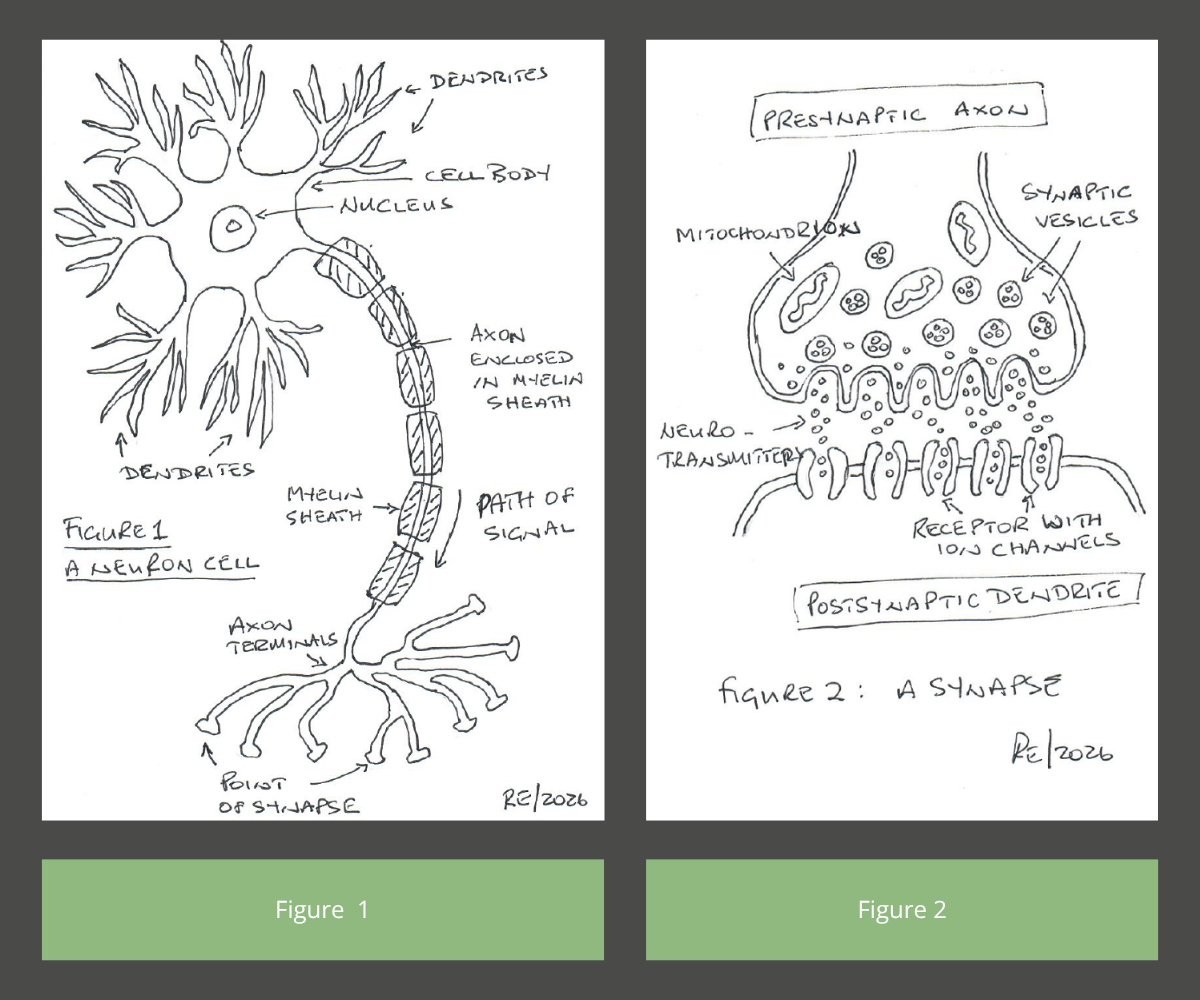
The autonomic nervous system which regulates involuntary actions, e.g. heart rate, respiration and digestion, is the other half of the peripheral nervous system. In both animals and insects, their nervous systems function by the passage of electrical-chemical signals from one neuron to another. An electrical-chemical signal is generated in a neuron, which then passes along a structural part of the neuron called an axon, acting like a kind of communication cable. On reaching the tip of the axon, the transmitted signal stimulates the production of a particular neurotransmitter called acetylcholine. This is then released into a tiny gap between the axon and another neuronal structure known as a dendrite, located on a neighbouring neuron. The tiny gap is called the synapse (see Figure 2). Acetylcholine functions to carry signals from one neuron to the next across synapses. When passing from the axon of a transmitting neuron to a dendrite on a receiving neuron, the neurotransmitter acetylcholine targets and activates acetylcholine receptors (specialised proteins) located on the cell bodies and dendrites of neurons.
When human beings smoke and vape for instance, nicotine absorbed into their bodies functions as a stimulant by binding neurotransmitter receptors called nicotinic acetylcholine receptors. These are found on neurons within the central and peripheral nervous systems and also in tissues such as muscles. The act of smoking causes the release of neurotransmitters such as acetylcholine, as well as dopamine and norepinephrine, which collectively reduce anxiety, increase alertness and cause mild euphoria. Nicotinic acetylcholine receptors are one of two types of acetylcholine receptor, of which this one is important to the function of neonicotinoids.
In animal[1] and insect central nervous systems, the neurotransmitter, acetylcholine, is commonly but not exclusively involved in the function of synapses. When acetylcholine makes its way across synapses, it binds with the acetylcholine receptors on the dendrites of targeted neurons. This activates electrical-chemical signalling by targeted neurons which, by this process, then stimulate sequential signalling in the following neurons in the chain. By this process, signals from the human brain can stimulate and control the muscles in two hands, such that, for example, Beethoven’s Piano Sonata No. 14 in C♯ minor, Op. 27, No. 2, the Moonlight Sonata, can be performed flawlessly. Release of the enzyme acetylcholine esterase terminates neuronal signalling by rapidly hydrolysing the neurotransmitter. This is important. The constant activation of a neuron by a neurotransmitter can lead initially to an increase in the strength of nerve impulses, with increased efficiency in passing signals to a postsynaptic neuron. However, this will eventually lead to synaptic fatigue, impaired signal recognition, excitotoxicity (overstimulation causing damage) and neuronal death. In this we find the purpose of neonicotinoids.
As said, there are two types of acetylcholine receptors: nicotinic acetylcholine receptors and muscaric acetylcholine receptors. They are so named because one type binds strongly with nicotine, while the other binds strongly with muscarine, a naturally occurring toxic alkaloid compound found in poisonous mushrooms, e.g. Inocybe and Clitocybe species. Synthetic neonicotinoids behave in a manner similar to nicotine by targeting nicotinic acetylcholine receptors which are highly concentrated at synapses. In insects, neonicotinoids bind strongly to nicotinic acetylcholine receptors, blocking the action of acetylcholine esterase and preventing bound acetylcholine from breaking down, in order to terminate synaptic activity. Consequently, neurons continue to fire causing nervous fatigue, confusion and eventually the probable death of the affected organism, e.g. an insect.
Neonicotinoids are designed to be lethal to insects. They are however considered safe for humans because they do not bind strongly to human nicotinic acetylcholine receptors. This is due to structural differences between the receptor binding sites in insects and mammals. As systemic insecticidal compounds, neonicotinoids are highly water soluble and are absorbed into plant tissues to be transported by plant vascular systems to all parts. Even into nectar and pollen. Treated plants can remain toxic for weeks or months. Exposure to neonicotinoids is not immediately fatal to all insects. For instance, when honey bees (Apis melifera) forage for nectar and pollen from flowering plants, nervous system confusion caused by neonicotinoids can be sufficient to prevent bees from finding their way back to colonies. This then results in starvation and death.
In addition to the diverse functional properties that neonicotinoids present as systemic insecticides, they are also environmentally persistent in soils, with half-lives varying from several months to a year or more depending on soil conditions. Because they decay slowly and can accumulate in soil, repeated use in a given location can result in soil concentrations increasing over a number of years. This can then threaten harms to non-target organisms, including ground-nesting and solitary bees as well as soil invertebrates and microorganisms, etc. Additionally, the hydrophilic (water-solubility) propensity of neonicotinoids enables them to move readily through soil, then to leach into groundwater.
[1] Not all animals have central nervous systems, e.g. cnidarians (jellyfish, hydra), although acetylcholine with a different function is found in these organisms.
Where to from here?
As with all synthetic pesticides, neonicotinoids raise various practical, ecological and moral concerns. As a class of insecticide they are extremely effective in eliminating insect pests, thereby helping to maximise crop yields and farmers’ incomes, both of which are necessary features of socio-economically viable food systems. However, concerns about the effects of neonicotinoids on agricultural and wider ecosystems, as well as agricultural sustainability given the potential of neonicotinoids to devastate insect pollinator species and populations, has led to U.K. government policy interventions with stringent controls over use. In 2018 use of three main neonicotinoids on outdoor crops was banned, although limited use in some applications is still permitted. Part two of this two-part article will examine use of neonicotinoids from perspectives of food and environmental ethics, and particularly concepts of moral duty and obligation with regard to the natural world, farming and the socio-economic importance of farms and farm viability, as well as with respect to the scientific and public spheres.
Ralph Early, Member and Trustee, Food Ethics Council
Featured image by James Baltz via Unsplash.